
Demystifying AI: What Artificial Intelligence Really Is and How It Works Under the Hood
Artificial intelligence is the buzzword of our time. But what lies under the hood of algorithms like ChatGPT or Tesla's autonomous systems? Let's explore how AI processes data, how it differs from machine learning, and why it is pure mathematics rather than magic.
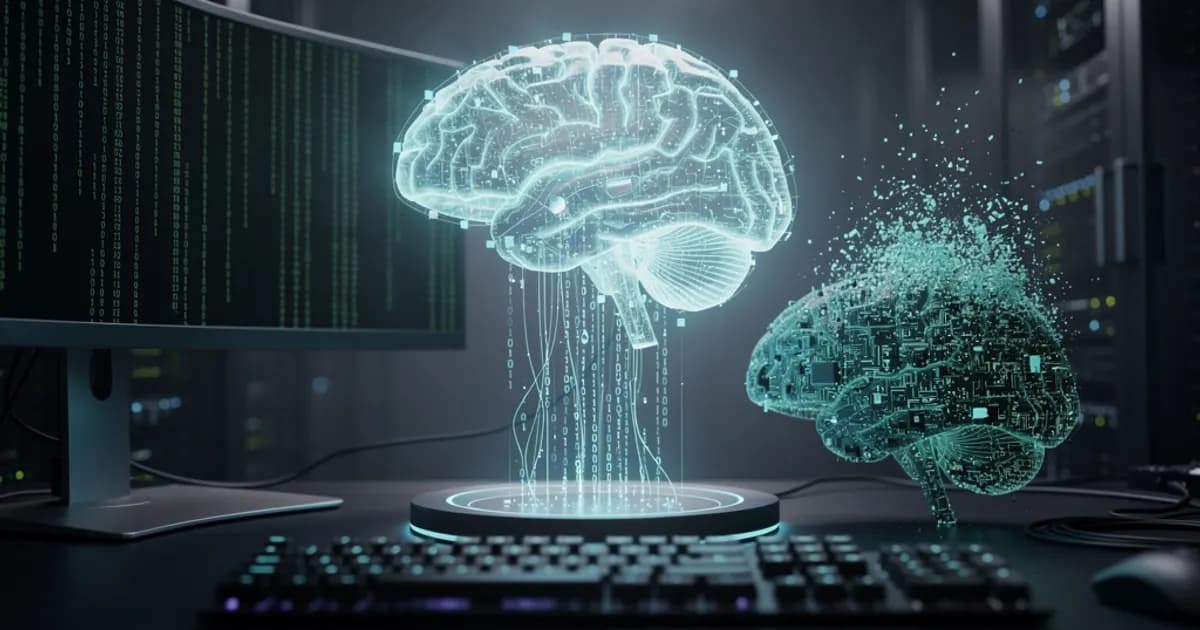
- Artificial Intelligence (AI) is not a conscious entity, but advanced systems that analyze data and recognize patterns.
- Modern technology is so-called Narrow AI – specialized in performing a single, specific task.
- Machine Learning (ML) and Deep Learning (DL) are subfields of AI; DL is based on multi-layered neural networks.
- AI's operation relies on a triad: high-quality data (fuel), algorithms (rules), and models (the result of training).
- Language models (e.g., ChatGPT) do not understand the meaning of the words they generate – they operate on statistical probability.
Artificial Intelligence (AI) is probably the most overused term of recent years. We hear about it in the context of medicine, autonomous vehicles, image generation, or chatbots like ChatGPT. It is easy to fall into the illusion that we are dealing with a digital consciousness that is about to take over the world.
In reality, the matter is much more pragmatic. As engineers and architects, we must discard the marketing hype and look at AI through the lens of technology. In this article, I will explain what artificial intelligence really is, how it evolved, and how its mechanisms work under the hood.
What Is Artificial Intelligence?
Simply put, artificial intelligence is a field of computer science dedicated to creating systems capable of simulating human cognitive processes. This includes learning, reasoning, self-correction, and adapting to new data.
However, it is worth emphasizing strongly: modern AI is not "conscious" or "intelligent" in the human, biological sense. It has no emotions, intuition, or free will. These are advanced computing systems that analyze massive volumes of data, detect correlations within them, and make decisions or generate outputs based on that.
We encounter AI-based technologies at every step in our daily work and lives. Here are a few classic examples:
- Recommendation engines (e.g., Netflix or Spotify matching content to user tastes)
- Autocorrect and predictive text algorithms in smartphones
- Computer vision systems (e.g., facial recognition or object detection on the road by autonomous cars)
- Smart voice assistants (Siri, Alexa)
- Advanced generative models (ChatGPT, Copilot, Gemini)
Each of these systems relies on a simple pattern: it takes input data, processes it through a trained mathematical model, and returns the most likely output.
A Brief History of Artificial Intelligence
Contrary to appearances, AI was not born with the release of GPT models. Its foundations were built over decades, passing through periods of great optimism and so-called AI winters (periods of stagnation and lack of funding).
The 1950s – The Birth of the Idea
In 1950, Alan Turing published a groundbreaking paper in which he asked the question "Can machines think?" and proposed the famous Turing test. The term Artificial Intelligence itself was coined shortly after, in 1956, during the legendary Dartmouth conference.
The 1960s–1980s – The Era of Expert Systems (Symbolic AI)
Early approaches to AI relied on formal logic and rigid rules (the so-called "if-then" approach). Engineers tried to manually encode all human knowledge in the form of decision trees. These systems worked well for narrow, well-defined problems (e.g., simple medical diagnoses), but completely failed when faced with the chaos of the real world, such as trying to recognize handwriting.
The 1990s–2000s – The Shift Toward Machine Learning
Instead of writing thousands of rigid rules, scientists began designing algorithms that could learn independently from provided data. This marked the birth of modern Machine Learning. The computer started searching for patterns on its own and optimizing its performance based on statistics.
Post-2010 – The Deep Learning and Big Data Revolution
The explosion of data (Big Data) and the widespread adoption of graphics processing units (GPUs), which excel at matrix calculations, led to a breakthrough. Architectures based on deep neural networks (Deep Learning), and later on transformers (introduced in 2017), allowed for the creation of models that can process text, images, and audio with accuracy surpassing humans.
Classification of AI: From Narrow Systems to Superintelligence
In theory and practice computer science, AI is divided into three main categories that define the level of advancement and versatility of the system.
1. Narrow AI (Weak / Narrow AI)
These are systems designed and trained to perform a single, specific task. This could be playing chess, translating text, or filtering spam. Although the system may seem incredibly intelligent, it cannot transfer its skills to another domain. All modern AI systems, including LLMs, are narrow AI.
2. General AI (AGI)
Artificial General Intelligence (AGI) is a system that would possess human-level cognitive abilities. It would be able to learn any intellectual task, adapt to new situations, draw conclusions from various fields, and build abstract concepts. At this moment, AGI remains purely in the realm of theory and research.
3. Superintelligence (ASI)
A vision of a system that far surpasses human intellect in every possible field – from artistic creativity to science and social skills. This concept is frequently explored in science fiction literature and in debates regarding the safety and ethics of technology development.
How AI "Thinks" Under the Hood
To demystify the magic of AI, it is worth looking at its three fundamental pillars: data, algorithms, and models.
Data as Fuel
Without data, there is no machine learning. For a model to be able to recognize, for example, anomalies in X-ray images, it must first analyze thousands of correctly labeled images. The quality and representativeness of this data directly determine the effectiveness of the final system.
Algorithm as a Rule Processor
An algorithm is a mathematical recipe for how the computer should process training data. It defines how the neural network should modify its internal parameters (weights) to minimize errors during learning.
Model as a Finished Product
A model is the direct result of the training process. It is a complex mathematical structure (e.g., a neural network with billions of weights) that can take new, previously unseen data and generate an accurate prediction for it.
AI vs. Machine Learning vs. Deep Learning
These terms are very often (and incorrectly) used as synonyms. In reality, we are dealing with a nested relationship (inclusion):
Deep Learning ⊂ Machine Learning ⊂ Artificial Intelligence
To better illustrate this, it is worth looking at the division of roles:
- Artificial Intelligence (AI) is the broadest term – an entire branch of science aiming to imitate human behavior through machines (both via code and statistics).
- Machine Learning (ML) is a subfield of AI based on the idea that systems can learn independently from data, rather than being explicitly programmed.
- Deep Learning (DL) is a specialized part of ML that uses multi-layered neural networks to analyze complex patterns (e.g., in images or text).
Can Modern AI Think?
This is a fundamental question, to which the technical answer is: no. Modern AI systems do not understand semantics, have no consciousness, and no intentions. They operate based on advanced statistics and probability theory.
A good example is Large Language Models (LLMs). When ChatGPT answers your question, it does not "think" about the meaning of the statement. Based on billions of parameters, it calculates which word (or token) should statistically follow the previous one so that the text sounds coherent and logical to a human. This is an extremely advanced mathematical illusion of intelligence – but still only an illusion.
Understanding this boundary is crucial for every architect and data engineer. AI is a powerful tool for optimization, automation, and predictive analysis, but we – humans – still provide the context, purpose, and critical evaluation of its results.
Ready to get started?
Got something I could help with? Get in touch — happy to share what I know.
Get in touch